[The bulk of this is a retelling of and musing on a paper by David Lewis, but without any of the actual good philosophy–in essence, it’s a less artful way of presenting the same ideas. For some good philosophy, read the paper.]
David Lewis ruined my day
Please, let me ruin your day.
Consider the following scenario: you’re about to enter into a Star Trek teletransporter that will disintegrate your body here on Earth and put you together in the same configuration on Mars. You step onto the platform, hear the operator press the button to begin the process, and so close your eye in anticipation. Then…nothing. You open your eyes, still on Earth. The machine, it turns out, has malfunctioned and failed to disintegrate you. Nevertheless, as you can see from the familiar face smiling back at you from Mars, it worked well enough to put together a copy of you there. Which one of those people is you?
An embarrassment waiting to happen
This question is, in one sense, unimportant. Some people think that both people are you. That may be right, but I happen to think that from your point of view (regardless of who you actually are) the question will seem absurd. You are the person who has your subjective, first-person view and that’s just the person who has this point of view. No other person has, or, indeed, can have this point of view, regardless of how much he looks like you, what they say, what kind of history or memories they have. So, while the question of who’s the real you might pose a problem from the third person perspective of the embarrassed teletransporter technician, it will never be a problem for you.
The same point, of course, applies to whatever or whoever your doppleganger is on Mars. For him, there likewise isn’t any question about who the real him is–it’s the person who has his point of view, i.e. him. And the same point applies to you who are reading this.
The same thing will be true if tomorrow you woke up with an entirely new body. If, for example, you were cursed to inhabit the body of your teenage daughter this Friday, on waking up and taking your usual first-person perspective, the question of who you are would never arise. You might think to yourself “my god, I’m in my daughter’s body!” but you would think “my god, I am my daughter!” That’s just a mistake you could never make–you could never mistake yourself for somebody else from your own perspective. You are necessarily the one who has this perspective and this perspective can’t be somebody else’s.
I also believe the same thing will be true if you woke up with all of your memories wiped clean (well, at least those memories that don’t involve remembering how mirrors work or how to speak or whatever. Play along!). In that case you might in some sense be wondering who you were, but you would still know that whatever the answer to that question is, you’re still now the person who is looking out from these eyes and who’s trying to piece things together. Subjectively speaking, there’s no deep question about your identity.
Never answer the phone
Back to the teletransporter. Suppose that instead of malfunctioning in the way that it did, a different mistake had happened. Once again, you remain unharmed on Earth. However, when you peek at the screen broadcasting from Mars, you hear screams of horror and see something that looks like your lifeless body, crumpled on their receiving pad. Did you die? The answer is, of course, no. You are where your first-person perspective is and that’s here on Earth where you are very much alive. Furthermore, if you were to die, you couldn’t have any first-person perspective. Necessarily, you can’t experience being dead since do be dead is to have no experience whatsoever (maybe if you have a soul you could still have the perspective from your heavenly ethereal body, but that would still be living a kind of life–an afterlife–and there, too, you would know it by taking this first person perspective). To dust off the old adage: wherever death is you are not, and wherever you are death isn’t. Whew–close one.
Your trials aren’t over just yet. Imagine yourself as the victim of a Schroedinger inspired act of cruelty. You’re put in a cell with a bottle of a deadly nerve agent that is hooked up to a photon detector, which, if triggered by a photon will smash the bottle, release the gas, and kill you. A photon is set to be fired into the detector, but in its way is set up a diagonal half-silvered mirror. In one scenario, there are no collapses (see the Lewis article for the full explanation of what those are), the photon goes into a superposition, hits the mirror and bounces away, the photon detector goes into a superposition of untriggered, the bottle into a superposition of not-smashed, and you go into a superposition of remaining alive. In a different scenario, there are collapses and, well, things don’t turn out as well for you.
It you.
You realize all this. What does it look like from your perspective? What should you expect? Well, if there are no collapses, then you should follow the intensity rule: “expect branches according to their intensities” where branches are the resolutions of the quantum indeterminacy and intensity is a measurement of the likelihood of different events occurring (I’m doing my best here–I don’t know anything about quantum mechanics). In this case, you should expect equally to be alive as well as dead. But, as we just saw, you shouldn’t expect to be dead! You can’t have that experience at all since that’s not an experience you can ever have! So your expectations should be adjusted and you should expect to be alive. In fact, no matter how many times your captor repeats this process you should expect to remain alive. As long as there are no collapses, you’ll always survive your torture.
You can think of this in terms of branching timelines. On one branch (from a third-person perspective) you die, and on the other one you live. The more times the torturous experiment is repeated, the fewer branches there are in which your survive. If there is collapse between the different branches, then, sadly, you will die. However, if there’s no collapse, then there are at least some branches in which you survive. And given that you will always be where your perspective is, and that there is no perspective in which you are dead, there is also no branch in which you will be dead. Thus, you should expect to always survive this experiment.
The same is not true for your torturer. For him, there are plenty of branches in which you die, but this is fine since we’re not asking what he should expect, but only what you should.
Nevertheless, we can ask what he should expect with respect to him and the answer will be very much the same as with you. That is, if there’s no collapse, he will never find himself on any branch in which he‘s dead, though, again, many of those branches involve your deaths.
This point generalizes. One doesn’t need to be in a torture chamber to risk death and it’s clear that there are many events that could occur that could result in death. These can be chemical, biological, or mechanic. Regardless, from your perspective, however, you shouldn’t expect to ever find yourself on any of those (though, of course, I should expect it for you).
So, if there’s no collapse, you should expect to live forever. If there is, however, you should definitely not expect this. So, is there collapse? How would we know? Well, here’s the rub: if there is collapse, then you won’t be able to get evidence of it since, as Lewis says, “its prediction is that in all probability you will die soon.” And once you’re dead your death can’t be used as evidence of any kind for you since you won’t be the kind of thing that will be able to assess evidence–you’ll be a corpse. Notice, also, that the deaths of others won’t give you any kind of evidence as to whether or not there’s collapse. The fact that someone (in fact, everyone!) else has died is compatible with you continuing to live in a non-collapse universe on a branch where someone else has died. The only way you could get evidence that there is collapse is if you died. But then, to repeat, that won’t be any evidence for you.
Should you believe that there’s collapse? Well, you are, of course, free to try dying, though if you’re successful it won’t matter to you anymore and it won’t make a difference as to whether anyone else should believe that there’s no collapse. If you survive, however, you have stronger evidence and the more improbable your survival, the stronger the evidence. As Lewis advises us:
If someday you find that you have survived a remarkably long sequence of dangers, the no-collapse hypothesis will then deserve your belief more than it ever did before.
So, the longer you find yourself alive, the more you should believe that there’s no collapse. Furthermore, you’ll never find yourself not alive (wherever you are, there you are), and, given that you’ve made it this far…
BUT YOU SAID THIS WAS BAD NEWS! WHY DOESN’T THIS SHOW THAT I’M GOING TO LIVE FOREVER?
If there are no collapses, then you really will live forever. But that doesn’t mean you won’t age, grow infirm, diseased, and incapable. Furthermore, while in your timeline you will always survive regardless of what happens to you, from your perspective nobody else will. Everyone else around you will age and die as you, the oldest person alive, will, in all likelihood, continue to survive in constant agony. Even if you tried to kill yourself, you would necessarily find yourself in the timeline in which the gun doesn’t go off, the poison doesn’t work, and the rope slips. Even worse! You might very well find yourself in the timeline in which the gun does go off, but only maims or; the poison does work, but only makes you horribly ill; and the rope doesn’t slip, but only paralyzes you! And this applies to every single person!
Happy Friday!
A silver lining and an addendum:
First, if there’s no collapse you might be able to live a less horrible life in the far future in which horrible infirmities and aging can be reversed though, say, tremendous scientific advances. You would still inhabit a world in which everyone else dies and you continue to live forever, so that’s a bummer, but it’s better than the alternative! Given that in every timeline you’ll necessarily be the person who has lived the longest, you’ll probably get some special preferential treatment in testing!
And note, if everyone believes that there’s no collapse sufficiently strongly, everyone can get to work on making these scientific advances. True, from each person’s perspectives, everyone around them will die, but collectively, we might be able to make it so that in each person’s timeline science is advanced enough to keep the misery at bay.
So, really, the worst is getting through the time that you’re alive now until the science gets really good. Furthermore, once you become convinced that there’s no collapse, you should definitely volunteer to be tested on since you’ll speed up the process and will know that you’ll survive (in whatever miserable state that is) regardless. That might make waiting through that horrible middle phase go much faster.
Chin up, fellow immortal! It’s only a matter of surviving hell for a couple of hundred years. Then it’s just permanent solitude until the heat death of the universe!
Finally, let me add that I know I’ve butchered the quantum mechanics stuff and that I’m not doing justice to Lewis. Relax. This is just another thing you’ll survive.
Alright, let’s turn to Chapter 2 of TSaR (could there be a more fitting acronym?!). Discussion of Chapter 1 can be found here.
Chapter 2: The State and Revolution. The Experience of 1848-51
The Eve of the Revolution
Summary
As stated at the end of the previous chapter, Lenin is going to take us through Marx and Engels’ treatments of the revolutions of 1848 and 1871 as evidence that his (Lenin’s) interpretation of the need for a violent revolution is correct. This particular section deals with Marx’s thoughts prior to 1848 and with remarks in The Communist Manifesto.
Specifically, Lenin zeroes in on a passage from the CM about the development of the revolution.
The first step in the revolution by the working class, is to raise the proletariat to the position of ruling class, to win the battle of democracy. The proletariat will use its political supremacy to wrest, by degrees, all capital from the bourgeoisie, to centralize all instruments of production in the hands of the State, i.e., of the proletariat organized as the ruling class; and to increase the total of productive forces as readily as possible.
The Communist Manifesto pg. 37 in the 7th German Edition 1906 (Lenin’s citation)
What’s crucial for Lenin in this passage is this last definition of the proletariat state as a ruling class. It is this definition that Lenin sees as advocating for the infamous ‘dictatorship of the proletariat’ (a phrase, I should say, appears like once in a letter that Marx wrote), and it is this definition that the moderates surrounding Lenin fail to account for in their approaches to revolution.
Putting together what we’ve learned already, then, we get something like the following picture: the state is always necessarily a tool of class oppression, the bourgeois form of which must be destroyed by the proletariat and supplanted with a proletariat state that subsequently withers away. This latter state is the proletariat itself organized as a ruling class, and since the state always remains a tool for oppression, then it must be a directed oppression against the bourgeoisie by the proletariat until the aforementioned withering is complete.
More succinctly, the existing state must be destroyed and replaced with an organized ruling class of the proletariat who finish off the capitalist exploiters.
This vision of the state as a ruling class comprised of the proletariat and oppressing the is one that is starkly at odds with any moderate position which sees a kind of peaceful co-existence between capitalists and the proletariat. These positions, claims Lenin, are utopian and are at the root of the failure of the 1848 revolutions; to take such a moderate position in 1917 would be tantamount to distorting Marx and making the same mistake again.
Furthermore, Lenin argues that only the proletariat class can overthrow the bourgeoisie since only it, through its role in economic production, can unite all the disparate peoples who are oppressed by the capitalists.
Lenin then summarizes what he takes to have shown:
The teaching of the class struggle, when applied by Marx to the question of the state and of the socialist revolution, leads of necessity to the recognition of the political rule of the proletariat, of its dictatorship, i.e., of power shared with none and relying directly upon the armed force of the masses. The overthrow of the bourgeoisie can be achieved only by the proletariat becoming transformed into the ruling class, capable of crushing the inevitable and desperate resistance of the bourgeoisie, and of organizing all the toiling and exploited masses for the new economic order.
The proletariat needs state power, the centralized organization of force, the organization of violence, both to crush the resistance of the exploiters and to lead the enormous mass of the population–the peasantry, the petty bourgeoisie, the semi-proletarians–in the work of organizing socialist economy.
The State and Revolution Chapter 2, pg. 30
Lenin then closes with a refinement of this general argument to work in the role of the worker’s party. I believe it’s supposed to go something like this: if this reading of Marx is correct (and Lenin has no doubts that it is), then the state, as we’ve seen, needs to be used as a tool of oppression and violence against the bourgeoisie. But if that’s the case, then the state can’t include the bourgeoisie, and will only be comprised of the proletariat. But since the vast masses that comprise the proletariat have been broken up by the bourgeoisie, it falls on a particular sector of the proletariat to take up the mantle of the state and do the necessary work. Which sector is that? Well, it’s the one that best understands Marxism and which has a consciousness advanced enough to only oppress the former oppressors; i.e. the worker’s party informed by a proper understanding of Marx (i.e. surprise, surprise, the Bolsheviks).
Analysis
I admit, I’m struggling a lot with this section. Lenin moves really quickly, but it seems to me that the crux of the entire argument rests on the simple equation of ‘state = tool of oppression against a rival class’ and ‘state = political rule’, along with an equivocation between oppression, force, and violence.
If the proletariat state is defined as an organized political rule by the proletariat class, and if any and every state is always a tool of oppression by one class against another, then substituting the middle terms, it follows that political rule by the proletariat class will be oppressive against the rival capitalist class. If, furthermore, oppression is force is violence, then it follows that political rule by the proletariat class will be violent against the capitalist class. What also follows from this is also that any political rule will always be (and has always been) characterized by the use of violence against its opposing class.
This argument seems, at the very least, valid. What’s crucial here is whether the posited equivalences are true. This takes us back to the perennial question of whether the state is necessarily a tool of class oppression–a question which I’ve set to the side for this first reading series but which we’ll pick up later. But let’s grant that for now and set that equivalence aside. Now, it’s clear that Marx endorsed the second equivalence between state and the exercise of political rule held, so, Lenin’s point carries: the proletariat state would, indeed, be a state in which the proletariat exercise political rule. What we’re left with, then, is the question of whether the exercise of political power is necessarily the exercise of violence by one class against the other.
Here, I begin to chafe a bit. It seems to me that there are at least two ways to think of the exercise of political power here. One is put in terms of the ability to cause violence and oppress, the other is put in terms of the actual use of violence and oppression. On the former view, one class has political power just in case it can cause violence against the other class (even if such violence is never used); on the latter, one class has political power just in case it does cause violence against the other.
The difference between the two can be illustrated as the difference between my having a handgun so I can fight off a potential burglar who comes into my house and my having a handgun and using it to actively hunt down burglars in my neighborhood. One view on power says that I have power in both cases (and am using it if and when I shoot a burglar); the other says that I only have the power insofar as I’m shooting burglars.
Taking this analogy to the state level, one might say that by gaining the ability to rule politically the proletariat state acquires the means to defend itself through the use of violence against the intrusions of the formerly powerful bourgeoisie. Now, this is markedly different from the stronger claim that in taking power the proletariat state must use violence to crush its opposition since that’s just what it means to have political power. This stronger reading takes it that there is no political power unless it is actively used to oppress and cause violence against the bourgeoisie while the weaker reading takes it that one can have political power insofar as one has the ability (used or otherwise) to cause violence to them.
The important point is that this distinction leaves room for a view of political rule in which the use of force and violence is reactive rather than proactive. This is perfectly compatible with the claim that the state is always a tool for oppression since, after all, tools retain their powers even when they’re not in use. It is also compatible with the claim that the state is an organization of political rule if we we grant that political rule involves the possibility of using force and not simply its actual use.
Again, the difference here in practice is the difference between having a political body which capable of defending the revolution with arms and a political body whose purpose is to kill the enemies of the revolution.
I think it’s not exactly clear which version Lenin is advocating for here. If I squint hard enough I can see him as strictly advocating for the former, weaker version–after all, he does say that the proletariat must transform itself into a class “capable of crushing the inevitable and desperate resistance of the bourgeoisie” [emphasis mine]. Thus, one could read him as merely arguing that the proletariat class must be one that violently overthrows the oppressive state, then maintains its monopoly on violence until such a time that it is no longer needed. But part of me thinks that he’s really pushing for the stronger view that the rule of the proletariat state needs to be proactively violent until there’s no more classes to be violent against.
I don’t see the weaker version as objectionable. Or, at the very least, I don’t see it as unreasonable. However, the stronger version still makes me uncomfortable since it seems to rely on this kind of fetishization of violence that I just don’t care for. I’m also not convinced that the view of power that underlies this version and which rests on the claim that power just is the active use of violence is a good one.
Finally, something needs to be said about the role of the party that sneaks into the very end of the section and which lays the grounds for a single party state. I tried to present the argument in the most charitable way possible in the summary section by pointing out that the way the definitions of the state and political power are laid out excludes the possibility of a state that’s comprised of bourgeois and proletariat parties. This might be true, but it’s clear that Lenin has set things up that makes it almost impossible for a plurality of, say, proletariat parties to work in a state as well. This is because every party that has the same (proper) reading for Marx will, de facto, just be the same party, and every party that doesn’t have that reading will either be opportunistic, or in the worst case, a class enemy that must be destroyed to protect the revolution. What this means is that there will always be one party that has things right, and a bunch of others that must either be defeated or united by force under the party doctrine.
This, for what it’s worth, is something that it seems to me comes purely from Lenin and isn’t to be found in Marx. He doesn’t use any quotes from Marx or Engels to support this, and it seems to me to be entirely brought in from Lenin’s own views about the importance of the party.
“Look over there! Enemies of the revolution!” – Lenin (probably)
2. The Revolution Summed Up
Summary
So, what did Marx make of the ’48-’51 revolution? His full assessment is in The Eighteenth Brumaire of Louis Bonaparte (EB) from which Lenin specifically focuses on Marx’s claim that the revolution failed in France because it tried to work within the state. Here’s Marx:
The parliamentary republic finally, in its struggle against the revolution, found itself compelled to strengthen, along with the repressive measures, the resources and centralization of governmental power. All the revolutions perfected this machine, instead of smashing it up. The Parties that contended in turn for domination regarded the possession of this huge state edifice as the principal spoils of the victor.
Lenin quoting Marx. Italics Lenin’s
In short, this passage confirms what Lenin had presented in chapter 1 in his discussion of Engels: the state is not something that can be co-opted by the revolution, but something that has to be overthrown, destroyed, and replaced.
Lenin then walks us through a brief description of the history and development of the modern bourgeois state in France. In doing so, he gives a more specific explanation of something else that we saw previously in Engels–namely, he outlines how the agents of the state come to have the interests of the ruling class rather than the oppressed class. Unlike the general remarks we saw earlier, this is an explanation of how this specifically happens in the bourgeois state as we recognize it and how working within the state failed under the specific conditions of ’48-’51.
Regarding its birth, Lenin says the bourgeois state forms with the collapse of absolutism and feudalism (think 1789 and its consequences). Crucially, this state is primarily characterized by two institutions that displace the existing ones that preceded it: bureaucracy and the standing army [side note: prior to the French Revolution, the majority of warfare was a job for nobility and hired mercenaries; it was only following the French Revolution and the threat posed to it by the monarchs of Europe that the concept of mass conscription and a standing republican army takes hold. For a really really good book on this check out David Bell’s The First Total War: Napoleon’s Europe and the Birth of Warfare as we Know it.] These, in turn, stand as “a parasite on the body of bourgeois society” which it needs in order to suppress, repress, and contain class antagonisms. And it is through these organizations that the state evolves with each subsequent bourgeois revolution that spread on the heels of the French. New lessons are learned and the institutions are developed and perfected to suppress more effectively.
Crucially, what happens with each bourgeois revolution is the establishment of these two institutions, which, in turn, requires the appointment of government posts and positions of power. In filling these positions, the people who are involved in the institutions are separated and placed above the masses and apart from their interests. As parasites on the body of bourgeois society, their own survival depends on the existence of the bourgeoisie, and they come to be work for the benefits of that class.
Interestingly, Lenin doesn’t talk about how this played out in France, but illustrates this point with how the developments played out in Russia following the (bourgeois) revolution that overthrew the Romanovs. Following that revolution, notes Lenin, all the places of power that used to be populated by the Black Hundreds (ultra nationalist supporters of the tsar) simply were redistributed to members of some of the “moderate” Mensheviks, Social-Revolutionaries, and Kadets parties (each of which were, of course, Lenin’s enemies). Then, with that task complete, all talk of implementing radical changes and instituting reforms suddenly stopped or were indefinitely shelved.
Importantly, as this process of co-optation, betrayal, and inaction plays out, it does not go unnoticed by the proletariat, but serves to demonstrate just what they should expect from any moderates who want to participate in the state as a means of reform–viz., nothing. As the proletariat’s consciousness is raised through this realization, it becomes the best interest of the bourgeoisie and to more effectively perfect the state and its suppressive powers against its enemies.
The point, in all this, is, of course, clear: by participating in perfecting the state and working within it, the revolutionaries of 1848 did nothing more but strengthen the bourgeoisie’s ability to oppress. cannot improve the lot of the proletariat by working through the state, but, again, only by destroying it.
Anticipating an objection, Lenin notes that even if these conditions lead Marx to conclude that this is what the problem was in France in ’51, one may not be justified in extrapolating further than that. Can Marx’s claim be generalized? Unsurprisingly, given the fact that Lenin has already generalized it, he argues that it can. Here, the argument is that since ’51 the same process of consolidation of power against the proletariat has appeared in every country:
On the one hand, the development of “parliamentary power” in the republican countries (France, America, Switzerland), as well as in the monarchies (England, Germany to a certain extent, Italy, the Scandinavian countries, etc.); on the other hand, a struggle for power between the various bourgeois and petty-bourgeois parties which distribute and re-distribute the “spoils” of office, while the foundations of bourgeois society remain unchallenged. Finally, the perfection and consolidation of “executive power,” its bureaucratic and military apparatus
Lenin, The State and Revolution, Chapter 2, Section 3
The argument here is, I admit, a bit obscure, but I believe it’s supposed to be that in every developed country the impetus has been in working within the state–either through parliamentary politics or the re-assignments of offices in non-parliamentary governments, and never towards following any non-state interventions. I’ll return to why I find this argument odd below, but this is the best I can make of it here.
Finally, Lenin ends this section by noting that the global trend as of 1917 is towards imperialism, imperial war, and state-capitalism (note, he’s writing this years before the rise of fascism which makes state-capitalism it’s modus operandi), and that these forces are uniting to further oppress and suppress the proletariat populations of the world.
Analysis
I thought this section was one of the most interesting and most frustrating section so far. It’s interesting insofar as it describes the all-too-familiar process by which participation with the state blunts, subsumes, and defeats all promises of radical reform and change.
I can’t help but draw the parallels between Lenin’s haranguing of people who enter into office promising radical change only to be immediately sucked into the bureaucratic machinery, their promises of reform shelved, and the kind of disappointment that so many of us felt after Obama’s 2008 election. I don’t say that to place blame on Obama himself, but rather to highlight the fact that for many of us, the Obama promise seemed like a truly revolutionary one at the time and many of us seriously thought that with his election there would be some serious changes in place. Instead, nothing like that happened. Sure, I suppose some progress was made (though, to be honest, I’m finding it hard to see what that progress is in light of the last three years), but what was made clear to everyone was just how little could actually be accomplished while working from within the state bureaucracy. I’m afraid similar hopes have been hoisted on the Sanders campaign (a hoisting I’m guilty of as well) and that we’re still under the impression that if just the right people can get in office, then, everything would be alright. In that sense, Lenin’s description and analysis of the attempts to work within the state hits closer to home than I expected. So as far as putting his finger on an interesting phenomenon, Lenin remains an interesting read.
Nevertheless, I find the actual arguments really really thin! In fact, he doesn’t really put forward any arguments about the formation of the bourgeois state, its development, or the opposition that the proletariat must play (he doesn’t really even talk about France, as he says he will, but mostly draws on his own analysis of Russia!). Rather, he just asserts some claims without defending them, and then says that this has been proven by history. I’ve tried to fill in some of the details above (viz. the remarks about the development of the standing army), but even there I’m kind of speculating. Now, I know that he’s writing to a friendly audience that’s supposed to be familiar with Marx and, admittedly, I only got through half of the EB when I tried to read it, but I really wanted to see more. How does the bureaucracy of the modern bourgeois state prevent reform? Why does everyone who works within the state end up necessarily serving the bourgeoisie? (I tried to give a plausible answer to that in the summary, but I have no idea whether I’m right!)
Speaking of that, I also found it really interesting that nothing is said about the ability to enter into the state and destroy it from within. This, one might think, is what the republican party has been doing in the US since the rise of the Tea Party. It’s clearly effective and it can clearly further class interests (since all republican efforts so far have gone to benefit only the bourgeoisie), but it’s not an instance in which the state is violently overthrown. If so, then, it’s possible that the state can be destroyed by participating within it, but this is something that Lenin doesn’t consider. This is all the more strange given that Lenin’s own Bolsheviks frequently used participation in different organizations opportunistically to destroy them (side note: this was also the tactic used by some real chuds to destroy the grad union I used to belong to).
Finally, I found Lenin’s final argument about whether he’s justified to expand the lessons from ’51 apply outside of France really bizarre. What he needed to show was just as working within the state in France didn’t work in ’51, so working within the state wouldn’t work in 1917, and, presumably in 2019. What he does instead is show that the scope and power of the state is expanding everywhere, and then concludes from that that the conditions that held in France apply other places. But this is patently a bad argument! In fact, it relies on the very assumption that working within the bourgeois state is always bound to fail, and since there’s nothing but bourgeois states or states that function through this swapping around of surface appointments, there’s no reason to try. One could argue that there are notable differences between the material conditions of ’51 France and 1917 Russia, for example, that would make work within the former state a viable option. Or, perhaps, the argument relies on the never-before-established assumption that the stronger the state is, the more likely one is to fail in working within it. Now, this latter claim sounds interesting, but I couldn’t find anything in this section that amounted to an argument for it!
Like I said, frustrating!
3. The Presentation of the Question by Marx in 1852
Summary
The question to which Lenin is referring to here is the question of what is going to displace the bourgeois state once it has been destroyed. Marx’s answer, claims Lenin, is a dictatorship of the proletariat. Thus Marx says in a letter to a colleague in 1852 (the letter to which I referred earlier)
And now as to myself, no credit is due to me for discovering the existence of classes in modern society, nor yet the struggle between them. Long before me, bourgeois historians had described the historical development of class struggle, and bourgeois economists the economic anatomy of the classes. What I did that was new was to prove: 1) that the existence of classes is only bound up with particular historical phases in the development of production; 2) that the class struggle necessarily leads to the dictatorship of the proletariat; 3) that this dictatorship itself only constitutes the transition to the abolition of all classes and to a classless society
Lenin quoting Marx; Emphasis Lenin’s
Thus, argues Lenin, the real insight from Marx is not the importance of class struggle, which Marx admits was not his doing, but with the idea that the end of that class struggle requires a dictatorship of the proletariat. The bourgeoisie is perfectly content with accepting everything else in Marx except this last part, but it is precisely that which marks (pun intended) the real Marxist from those opportunists and reformists who do not understand his insight.
This is what Lenin’s arch nemesis Kautsky fails to see. Importantly, the exclusion of the dictatorship of the proletariat from limits all discussion within the acceptable bourgeois discourse and thus removes all revolutionary edge from Marxism.
Lenin ends this short section with two important claims: first, the dictatorship of the proletariat is a necessity–one cannot get to the true classless state of communism without this dictatorship; and, second, that this dictatorship remains a necessity until that classless state is reached.
Analysis
This section presents probably the most forceful argument Lenin has presented this far, but it all rests on what Marx meant by ‘dictatorship of the proletariat’. From what I know, this letter is the only time he uses this phrase and it’s not at all clear what he means by this. The language, of course, invites the worst and harshest reading and Lenin’s comments seem to imply that he intends to take the worst of them. For him, a dictatorship is necessarily violent and forceful, so if Marx advocates for a dictatorship of the proletariat, then he must also be advocating for the use of violence of the proletariat.
But it’s not clear that this is the only way to read Marx. One might think, for example, that ‘dictatorship’ here signifies the role of the person or group of people who set the rules despite the wishes of others. This may very well involve violence, but it does not necessarily imply it. The way in which it is implied is in the sense that violence may be used in those cases in which one, for example, takes up arms or seeks to undermine the authority or rule of those in charge. This is, of course, the way in which, for example, most ordinary people think that the state is authorized to imprison or harm people who refuse to pay taxes, kill others, or take up arms against the government. In this sense, the current state is also dictatorial and Lenin is right to say that this is a kind of dictatorship of the bourgeoisie. Now, clearly, there are cases in which this violence is proactive and patently unjust (e.g. the policing of black and brown bodies in the US), but this doesn’t mean that there isn’t a sense in which the use of violence is strictly reactive and used in self-defense. To repeat an earlier point, there’s a big difference between the active use of violence any and all enemies, and the right to defend oneself against those enemies should they choose to regain their previous position. The former still seems objectionable to me; the latter seems reasonable.
[Aside: the question of justice in this context is an interesting one that I can’t engage with fully here. I use the term in its colloquial sense. I understand that there’s an argument in the offing about how what counts as just or unjust is itself a product of the ruling class–a Thrasymachean argument–but I think such arguments are pretty weak. The very fact that we can recognize instances of injustice that go against the ruling power’s interests goes a long way, I think, to holding that the link isn’t as tight as such arguments make things out to be. In other words, I still think there’s an autonomy of ethics.]
This is all more the case if we consider that the end towards which the particular dictatorship is put forth is supposed to be genuine universal liberation. I am fine with a dictatorship that prevents the enslavement or rape of others and fully endorse the use of violence against the use of those who would take up arms or use violence in order to override such edicts. If the dictum is trueliberation, then it’s downright stupid to oppose violence in defending it (see my note on Engels’ remarks against Duhring in the previous post for much the same argument). Now, of course, there is always the problem of whether this is the end in question (here, again, I still think de Beauvoir has the best take), but this is an orthogonal problem (though very important one).
So, even if we grant Lenin that the revolution requires a dictatorship of the proletariat, the conclusions that should be drawn from this are unclear until we settle the question of what precisely is meant by this term. In fact, even if we grant that a dictatorship necessarily implies the use of violence, the question still remains as to what is meant by violence and to what purpose that violence is put.
To be fair to Lenin, he himself doesn’t make explicit the sense in which he understands the relevant terms(is this fair?!). What makes me skeptical that he takes the more moderate/reactive position that I’ve been pushing for here is the fact that he constantly moves between speaking of the use of violence needed to overthrow the state and the kind of violence that is to be involved in the dictatorship of the proletariat without any qualification. The former, I take it, is clearly an active violence, aimed at overthrowing an oppressor–there’s little doubt about that. The latter, however, can have this reactive reading. If Lenin thought of the violence regarding the dictatorship of the proletariat in any other way than he thought of the violence needed to overthrow the state, then, presumably, he would have made that distinction. But he doesn’t, and the fact that the two kinds of violence seem the same for him, makes me uneasy.
This is the second part of an essay, the first of which can be found here. It’s not necessary to read the first part, but I will be bringing in some claims that carry over from that essay into this one. In particular, I will hold that:
Fascists and Socialists both respond to certain social ills in society (poverty, war, economic inequalities, loss of traditional values, etc.)
Nevertheless, the two movements differ in two very important respects: first, they differ in how they diagnose the root cause of these problems. Fascists find the root cause in a change in the national character; socialists find the root cause in the capitalist mode of production.
And second, they differ in their ultimate proposals for resolving the problems. Socialists fight for abolishing the capitalist mode of production and fascists fight for the means of strengthening the nation.
In this part, given my own commitments, I will make the assumption that socialists are correct with respect to 2. I won’t make an argument for this assumption, but will only say that it’s much more clear to me how a capitalist mode of production could result in the problems under consideration than how anything like a national character, national spirit, or whatever would do the same. I’m happy to say more in the comments if people are interested, but I don’t want to spend too much time on that.
Furthermore, I will also assume that if the socialist proposal to abolish the capitalist mode of production is to be successful, it will only be so through a massive collective effort in which the people themselves seize the means of production and re-appropriate them for social purposes rather than profit. In short, I’m assuming that successful socialism will be built from the bottom up and not imposed from the top down through a revolutionary vanguard movement. I take this isn’t a radically strange assumption to make, but it is one that would need an argument against a Bolshevik position. I don’t provide such an argument here (though, feel free to read my continuing series on The State and Revolution for my thoughts on Lenin’s philosophy). I do, however, want to stress that my taking the bottom-up approach is not meant to imply the necessity of any kind of slow, building, incrementalism or parliamentarism. I’m not here rejecting such a (relatively) moderate position, but merely stressing that a bottom-up approach doesn’t require taking such a position.
Finally, I will make the further assumption that if what socialism requires is a bottom-up approach, then it also requires a previously developed shared class consciousness through which the problems produced by capitalism are interpreted and understood. In other words, it doesn’t make sense for people to seize the means of production if they don’t see seizing the means of production as the solution to the problems they face, and they won’t see that as a solution until they understand how the current mode of capitalist production creates those problems and what their role is in this mode of production. What a successful bottom-up approach requires, then, is a class consciousness which lets people see themselves as part of a certain economic class as it relates to certain other economic classes within the capitalist mode of production. To assume that there such a class consciousness isn’t needed in a bottom-up approach is, it seems to me, tantamount to assuming that the seizure of the means of production will happen by instinct or without forethought, organization, or purpose. And this seems absurd (or, at best, utterly naive).
Behind this last claim is the more general point that the nature of some problems is such that the solution to those problems only appears as a solution once certain background conditions are in place. That is, the solutions appear only once they’re situated in a particular interpretive framework. Furthermore, there are times when not only the solution but the problem itself is obscured without such a framework (c.f. Miranda Fricker’s Epistemic Injustice for a much more sophisticated and philosophical take on this point).
Beyond it!
As I’m writing this, the American left is, for the first time in my life (and the life of almost anyone else), having a revival. Here are just some anecdotal points that support this claim: in general, young people are being more critical of capitalism and more receptive of socialism (this link is a bit outdated, but I believe the trend remains the same); we’re seeing more and more young and solidly progressive candidates run in (and win!) elections; almost every candidate running in the Democratic party primary has (thanks to Sanders and Warren) been forced to take a further-left-than-normal position on universal healthcare, student loan forgiveness, free college tuition, income inequality, racial injustice, criminal reform, and climate change–many of these issues are actually being taken seriously for the first time ever; there seems to be a growing popular consensus against the pharmaceutical industry and its role in the opioid crisis; leftist proposals are resounding with surprising audiences; and, in general, it’s becoming more and more acceptable to call oneself a socialist. All in all, things appear to be looking up for those of us on the left.
Furthermore, we have a good explanation in hand as to why we’re seeing trends like these. Namely, we appear to be in the midst of an acute crisis of neoliberal capitalism that started with the gutting of the public sector under Nixon and Reagan, which continued through the Bush/Clinton/W/Obama era, and which has been topped off with the disaster that is the Trump administration and its open cronyism. In that time, unions were destroyed, workers’ rights were rolled back, American industry died, the wealth gap grew astronomically, and wages stagnated as capital consolidated its winnings. What the millenial generation (my generation) was left with at the end of all this is worse than nothing: massive amounts of debt, no pensions, no job security, no prospect of home ownership, no accessible healthcare, and, oh, yeah, an unsustainable climate crisis that threatens all life on the planet.
So, as people my age and older look around and see friends and relatives dying from opium overdoses, as we realize that we’ve picked up six-figure debts to get useless college degrees, as we’re forced to live with roommates through our thirties just to make rent, as we make note of the fact that many of us haven’t been to a doctor or dentist in years, and as we come to terms with the fact that we’ll never have anything more than a precarious existence, we finally understand that nobody is going to save us and that the only means of stopping this is immediate collective action. Briefly put, we’re realizing that capitalism is making us miserable and that the question once again is (as it always has been) between socialism and barbarism. The reason we’re seeing a revival on the left, then, is because the situation has become unbearable and we’re on the precipice of a brave new world in which the revolution may once again become a real possibility.
That at least is the optimistic story.
Dreamy
Ever the pessimist, however, I think that this story, while partially correct and inspiring, is not quite accurate and that we should be much more worried about the trajectory on which we’re headed.
Let me explain. I think that we are, indeed, in a the midst of a crisis of neo-liberalism that has produced serious problems for the majority of people and engendered a palpable populist resentment in the population. People really are suffering and there seems to be a shared sense that something must be done soon to resolve these problems. However, this moment of crisis is not something that only the left recognizes and is aware of. Just as both the communists and fascists were responding to the same problems of capitalism in the early 20th century, so our modern day reactionary far-right and far-left movements are doing the same. And, just as the communists and fascists of the early 20th century responded with different diagnoses and solutions to the problems of their time, so our respective sides are doing the same thing now.
Now, if the assumption I’ve made about the need for a bottom-up approach in the socialist solution is correct, then what matters is whether the majority of the masses–those people most hurt by the current crisis–endorse our socialist diagnosis and solution, or if those same people make a hard turn to the right. The problem comes in if I’m right about my other assumption that in order for these people to come to our side and embrace our diagnosis and solution, they must have a kind of shared class consciousness. This is a problem because, on the one hand, I have no faith that there is a developed class consciousness for the majority of people affected by this crisis, and, on the other hand, the kind of consciousness that’s needed for a hard right turn is pretty much already in place. I’ll address both points.
With respect to the first, my general impression of most average Americans is that they simply do not think of themselves in terms of class in the terms necessary to make sense of the socialist solution as a solution. In terms of class, most people, I think, think of themselves in one of two ways: they either see themselves as part of “the middle class,” membership to which seems to extend to everyone who’s ever lived in the suburbs or owned a car, or as temporarily embarrassed millionaires who may not currently be rich, but who are well on their way.
The first is, of course, an absolute illusion and the label of ‘middle class’ is, as far as I’m concerned, completely meaningless. I suspect the primary drive in people’s identification as middle class is the conflation of ‘middle’ and ‘average’. Thus, what people hear when they hear ‘middle class’ is something like ‘the group of average people’ and when they consider where they are they reason something along the following lines: well, I know that there are people that are much worse off than me, and I certainly know that there are people much better off than me, so I must be the average; hence, I’m middle class. The little adjustments people make (“oh, I’m upper-lower-middle class”) are just reflections on how they situate themselves in relation to those like them. Crucially, to think of one’s class as defined in this way is to think of one’s class as determined by one’s current financial situation, which is to say that it’s not to think about class in the socialist sense at all! The latter, I take it, is a matter of the role that one plays and is expected to play in the capitalist mode of production and that is something totally different from where one finds oneself in the mathematical average in relation to others. This, for what it’s worth, is why, for example, making the same salary is not indicative of having the same class status (you and I might get paid the same as graduate students, but if you stand to inherit property, land, and a company while I stand to get nothing, we don’t belong to the same class). The fact of the matter is that these things come apart and while the majority of people are, indeed, average, they are not middle class.
Undoubtedly, this fetishization of the middle class is also in part due to the fact that belonging to the middle class is constantly reinforced as being capable. To be of the lower class is to have failed, to be lazy, unmotivated, and stupid; to be of the upper class is to be hard-working, innovative, and smart; to be middle class is to be hard-working, competent, and ‘on your way’ to the top. This, I think, is why people also tend to view themselves in the second way mentioned above (i.e. as temporarily embarrassed millionaires): if one doesn’t think of themselves as lazy, stupid, failure (and who could live with that thought!), and if, at the same time, one realizes that they’re not where they want to be, then they must, by virtue of their competence and capability be in the middle class. But since competence, ability, and hard work are rewarded in America by becoming upper class, the current discrepancy between reality and ideology are explained away as a temporary setback–we’re middle class because we’re neither yet failures nor millionaires (but someday!). This, again, is just to say that even if people use the word ‘class’ in referring to themselves as being ‘middle class’, they are using the term in a entirely different way than we socialists use it.
[For what it’s worth, I consider the middle class to be comprised primarily of the managerial class that stands between the owner/s of the means of production (or the board of directors or whatever you want to call it) and those who actually do the physical or intellectual labor. They are always a minority. Apart from that, I’m also inclined to lump in certain members of the professional class whose role is to support the whole machine. These, too, are a minority.]
Now, in reality, most of the people who consider themselves middle class are either upper class (and do so out of a kind of incipient shame) or, more than likely, lower class. This isn’t to say that there aren’t people who accurately identify their class and understand its role in the mode of production. There are such people, but they strike me as a vanishingly small minority.
This kind of general mix-up and inability to see oneself as belonging to a particular class is, I believe, indicative of a general lack of class consciousness in America. Once again, I have claimed that the bottom-up socialist solution can only be seen as a solution if the people who are to implement it are capable of seeing why control of the means of production will resolve the problems they face. That, in turn, requires seeing oneself as part of a class that plays a particular role–i.e. having a class consciousness–and this is simply what we currently lack. The United States simply lacks an internalized, shared, meaningful category of class that can be plugged into the socialist framework.
What about the other side? I’ve stated that for any problem to be seen as a problem and for any solution to that problem to be seen as a solution, it must be nested in a particular framework. The framework that socialists need requires a kind of class consciousness that requires (at a minimum) the category or concept of class. By contrast, the far-right in its fascist guise needs different categories. They need the categories of race, sex, blood, character, morality, patriotism, spirit, and so on, along with the category of The Nation. Recall, as I’ve categorized it, the fascist diagnoses the problems brought about by crises of capitalism as problems in the national character (or one of the other categories) and proposes solutions that aim to fix those problems. Fascists might even take a critical eye towards capital, but, as always, this critical eye is one that looks at what capital is doing to the nation to corrupt it and how it can be reigned in to serve the nation better. What the fascist needs to have people see his diagnosis as the correct one and his solution as a viable one is to be able to employ the categories above in support of his framework.
Unlike us socialists, the fascist pretty much has his work done for him since the majority of people (across alllllll divides) use these categories to navigate social life and make sense of the world every day. Race and gender are, perhaps, the two most salient categories. There may be general confusion as to whether an individual belongs to the capitalist class or the proletariat class, but there can never be any doubt as to whether a person is male or female, or black or white. Society simply won’t allow it (c.f. Marilyn Frye’s “Sexism” on the former). In fact, the concepts of gender queering and race passing only make sense in the background of this deeply ingrained social practice to identify and categorize on the basis of race and sex (I call it a practice because while I see the practice of categorizing as something that humans necessarily do, I don’t think the practice of categorizing on the basis of sex and race as as necessary). Much the same can, I believe, be said about the other categories that the right requires.
And, of course, the concept of the nation is something that all flag-waving, red-blooded Americans are familiar with. So, there should be no doubt that the majority of people have mastery of that concept either.
Crucially, what matters with this concept of the nation is that it necessarily requires that some people be excluded and others be included. The central question with the concept of the nation is always “who’s part of it?” The question is, of course, never satisfactorily answered and we know this. All people were created equal and those of the nation were guaranteed with the rights of life, liberty and the pursuit of happiness, of course! Well, with the exception of those black folks over there who, thankfully, didn’t count as part of the nation! And the native people. And women. And immigrants. And the people of the territories. And foreigners in general And, well, frankly, everyone who didn’t own land. One way of reading the history of the United States is as one long struggle for the definition of who exactly gets to be included in the nation. (This truth has been partially obscured by the fact that, at least on the face of it, the requirements for who gets to be part of the nation were supposed to be pretty loose; hence the melting pot. But, as history tells us, in difficult times those requirements have been immediately tightened. This is happening now as well.) This is, of course, not new or surprising information for anyone, but it underscores the fact that this necessary concept has always been with us and is one that anyone who’s lived here even for a short time has mastered.
Now, what the fascist needs is to wed the concept of the nation with the categories and concepts of race, blood, sex, etc. and to put the blame on those latter concepts as they relate to the health and well-being of the former in order to explain the current crisis of capitalism. And this is precisely what is happening at the moment.
I don’t think that the people who voted Donald Trump into office are fascists. However, I do think that his campaign and administration (although operating as a baldfaced opportunistic kleptocracy) always have been. The very core of his campaign was built on literally restoring the nation, and the diagnosis it has provided for why the nation is doing poorly has, since the beginning been defined in terms of who is benefiting from the nation who shouldn’t be (these, for those of you who are unaware are, of course, illegal immigrants, then Arabs and Muslims, then black people in urban cities, then the feminists and educated elites who are out of touch with real Americans, and finally the globalists–I’ll let you figure out who those are). In short, since the beginning Trump’s campaign has united the concepts of nation and race, blood, sex, etc. as a way of explaining the problems brought about by this crisis of capitalism.
What’s changed since then that is worrisome is the fact that most conservatives seem to have come around to embracing something like this as well and are being completely open about it. (Here’s one example that is perhaps too on the nose but which I would be remiss not to bring up, namely, the Ohio lawmaker Candice Keller who blamed last week’s mass shooting in Dayton on gay people, drag queens, and open borders (her list of reasons is much longer!))
But all of this talk about Trump and conservatives is orthogonal. In fact, I might be completely wrong about the scope and extent to which this is currently a problem . Even in this unlikely scenario, what remains a worry is still the fact that the majority of Americans are already primed and have mastery of the concepts and framework of interpreting this crisis through the fascist ideology. By contrast, we on the socialist left lack the crucial necessary bit to gain popular support: class consciousness. And if the crisis of capitalism comes to a point, it seems much more likely that people will adopt a framework through which they can, at the very least understand the problems they face with the concepts they have than one which requires them to have new concepts.
Does this mean that we should give up? Of course not. Class consciousness can be generated–in fact, it must be generated–but it is not something that we should plan on happening automatically. We should not hope that the crisis will come to a head in such a way that everyone will just come to see the inevitability of socialism. This, I’ve argued, is much more likely to lead to fascism than it is to socialism. And if we want to avoid any vanguardist top-down imposition, we’ve got to get to work and we’ve got to work quickly since the problems that have been traditionally leftists talking points are beginning to be picked up by more and more fash sounding folks (consider, for example, this speech by Josh Hawley at the National Conservatives Conference; fans of philosophy will be glad to see Martha Nussbaum mentioned!)
Here, I’ll close out with just a suggestions on where efforts are desperately needed:
We need a coherent and consistent notion of what it means to be of a certain class that is readily available, easily communicable, and resonates with people in a way that doesn’t require them to first learn Marx. That’s not to say that this notion of class needs to be non-academic, but only that it shouldn’t require being the most pretentious person on the planet in order to get it.
We need to find a way to spread this notion to the most amount of people. In short, we need a propaganda arm. We leftists tend to write a lot, but this isn’t 1917 and people don’t get their information from Pravda (look, I’m guilty of writing this stuff for nobody to read this as well, so I’m not blameless). We have to find a way to make our point broadly accessible and appealing (Chapo Trap House is, of course, the prime example of an excellent way of doing this)
This needs to be communicated to everyone of the working class. This probably means having to communicate with people who we disagree with; it might mean having to communicate to working class racists and sexists (yes, there are plenty of those). This obviously won’t be the task of everyone, but the development of class consciousness cannot be contingent on whether or not one already has the right view on every other issue. If we rely on only the non-racists and non-sexists to have class consciousness, then we are not working with any kind of majority (in fact, we may already be done)
That being said, we can’t lose sight of the other things that we value. I think that the development of class consciousness is of absolute importance, but this doesn’t mean that we should, for example, make alliances with working class skinhead Nazi groups because they’re working class.
There are certainly more things to be said about this, and I’m eager to hear more in the comments, but I’ll leave it at that. The question, now, is whether there’s enough time to do this…
This essay is split into two parts: the first part–this part–explains why there is no substantial overlap between fascism and communism. This part is likely to be frustrating for many people for two reasons. First, it says nothing new; ultimately, I’ll argue that although there may be some surface similarities between the two, the two ideologies are not substantially similar. Second, it’s framed in a kind of academic approach that is…dry and indulgently charitable to a position that, again, I think is ultimately not one that should be taken seriously (a third reason to be frustrated is that, like everything else I write, while it’s written in an academic style, it is not academically rigorous). All that is to say that if you want to spare yourself these kinds of frustrations, you can probably skip this first part. However, if you have found yourself thinking that there is some such overlap, take a look.
The second part of the essay is concerned with the importance of class consciousness in avoiding fascism. The claim I defend in that section is that the current failures of neo-liberal capitalism are pushing us closer and closer to a position in which the choice between socialism or fascism will be a serious one again (I mean I think it’s always a serious one, but y’know), and that, crucially, we socialists are in a very bad position to swing that choice in our favor unless we can find some way of creating mass class consciousness. This part of the essay is likely to be frustrating for entirely different reasons, but it has, perhaps, something original to say. If you only read one part of this whole thing, read that part.
Part I: Fascists and Communists
I was having a conversation with a good friend last week (who I hope won’t mind me mentioning this) when we got on the topic of reading the works of difficult people. He asked me if I had read Mein Kampf and I said that I’d only read bits and pieces for various history classes in undergrad. He had read it and said it was a terrible experience (and a terrible book), but that he learned three interesting things from it: first, that it’s obvious that Hitler was always an antisemite and wasn’t shy about expressing it; second, that he was no capitalist and much closer to socialism than he expected; and third, that he wasn’t anti-communist because he had some kind of fundamental opposition to centralized planning or redistribution of capital, but because of his nationalism and antisemitism (communism is all about building international solidarity and Jews were pretty active in the party–or at least perceived to be).
The first point is certainly true (those are the parts I’d read for class)–it’s almost baffling that people didn’t take Hitler seriously given that his rhetoric is explicitly genocidal as early as 1925. The third point also strikes me as essentially correct and I’ll return to it in a bit (with a slight adjustment), but it’s the second point that I want to discuss here. Now, I think this point is mistaken, but I think the mistake is a pretty natural one and one that I think lends itself to the general belief that communists (and that label is usually extended to socialists) and fascists are two sides of the same coin or two ends of a horseshoe. In other words, the view is that the two ideologies have more similarities than they do differences.
This general view is, I think, not uncommon in the public. Here, for example is an absolutely, mind-numbingly bad article arguing exactly that (Dinesh D’Souza is cited multiple times…). On the face of it, it might not seem terribly implausible. In support of this view the most common claim involves pointing to the fact that both fascism and communism in the 20th century resulted in totalitarian regimes arguing that this must mean that they share some deep ideological commitments. This argument is pretty flimsy since it attributes a common cause on the basis of a common effect. Although this way of reasoning can work in some cases, it is clearly a bad way to reason in generally. As a simple counter example, just consider that winning the lottery and robbing someone both have the effect of enriching a person, but the two causes have nothing in common aside from the effect they produce. The same wet, hacking cough might be produced by either a certain virus or a certain bacteria, but this does not tell us that this virus and bacteria are substantially similar (except, of course, with respect to this particular effect!). Likewise, one might grant that fascism and communism have had the same effect of totalitarianism (or, implausibly, that they mustalways produce that effect) while still denying that the two views have anything substantially in common. Given that this isn’t a generally good way to reason, what would need to be shown is that the inference in question is a good one to make with respect to this case. And that requires a different argument.
[For what it’s worth, I think most people who make this argument don’t really care about whether the two ideologies are similar. Rather, they just want to make the point that they don’t like either view and they usually already make what I called the implausible assumption above that both views necessarily always produce the same effect.]
However, a mover sophisticated claim might be made on the basis of the particular claims that each ideology makes. Consider, for example, the Nazi party’s 25 point program which includes such provisions as: ” 11. Abolition of unearned (work and labour) incomes. Breaking of rent-slavery…13. the nationalization of all (previous) associated industries (trusts)…14. a division of profits of all heavy industries…15. an expansion on a large scale of old age welfare… 21. outlawing child-labor” These really do look pretty damn similar to Marx and Engels’ demands of the Communist Party in 1848 (yes, yes, I know about 80 years separates these two and what may seem progressive in one era can appear as the bare minimum in another, but humor me for a second). Simply put, if both groups stand for nationalization, abolition of rent, redistribution of profit, and the institution of welfare provisions, then could the two be that different? Isn’t it plausible, then, that the main difference between the two is merely cosmetic? So, perhaps the claim for significant ideological similarity can be made on the basis that both ideologies take issue with the same things and offer similar solutions to those issues.
Now, I still think this claim is mistaken and that, in fact, the differences between the two make the the two ideologies worlds apart. But this is a more sophisticated claim than the popular one I brought up first, and the apparent overlap between the the two ideologies still warrants some explanation. So here it goes.
Simply put, I think the claim that both ideologies take issues with the same problems is correct; both communists and fascists were (and are), in a certain sense, responding to certain problems of modernity: poverty, concentration of wealth, dangerous work conditions, senseless war, the erosion of certain social roles, the destabilization of traditional values, and, in general, a kind of precarious existence. These problems are genuinely serious ones, so it’s not surprising that different political ideologies would want to address them and put forward demands to combat them. In fact, it would be bizarre if they didn’t! To ignore these problems would be, in essence, to deny them, and such a denial is the privilege of people who don’t have to face them in the first place. There are, in fact, such people who subscribe to these ideologies of ignorance, but these ideologies are certain to be the minority, and are, in general, poor ways to build political movements.
Yet, it should be clear that the identification of a common problem does not entail a common ideology! If it did, then every political movement that takes poverty, war, loss of tradition, etc. (i.e. any political movement that insists on the status quo–that is to say, no political movement given what politics is about) would be identical with every other one. To put the matter another way, I can grant that communism and fascism share a genus on the basis that they share a common concern with certain common identifiable problems, but this does not make them the same species. And to the extent that someone wants to make the former claim (i.e. that fascists and communists are both concerned with the same large problems) without the latter (i.e. they are the same thing) I’m willing to accept the argument.
Still, one might push back and claim that the methods each side proposes to combat the common problem is what makes the ideologies significantly similar. It’s the fact that both groups advocate for the nationalization of industry, the end of rent-slavery, the redistribution of profits, and so on that supposedly makes them identical, and not the fact that they identify the same problems. Here we don’t end up in a position that collapses every political movement into every other political movement. After all, some movements propose combating inequality by progressive taxation, others by eliminating it altogether, and so on. And, yet, here we have two movements each of which advocates nationalization of industry, a redistribution of wealth, and end to profits from rent, and so on. Isn’t this enough to claim that the two ideologies share substantial overlap? Doesn’t this make them not only of the same genus but also of the same species, or, if not quite the same species then super close cousins?
This way of looking at the matter is more forceful than the last two under discussion, but I also think it really matters why, under what conditions, and for what purpose the methods are proposed. Consider a crude analogy: suppose that you and I are surgeons who are tasked with saving a patient with a gangrenous leg. We both see the same symptoms, we both recognize the threat to the patient that it poses, and we both propose amputation as a remedy. On the face of it, outside observers might reasonably infer that we share the same views about medicine, intervention, and cures (i.e. that we share a medical ideology). After all, we agree on these things whereas a different surgeon might propose minor surgical intervention (or no intervention at all!), so this makes us similar. However, suppose that you recommend removing the leg because you think that it needs to be done as a last resort to save the patient’s life and I want to do it as a means of deterrence to teach him a lesson so that he’s very careful with his other leg; or because I think that anytime there’s gangrene anywhere in the body, that body part must be removed; or because I think that when gangrene occurs in people that look like this patient, amputation needs to be performed, but otherwise it can be allowed to spread. I hope it’s clear in this toy case that despite the fact that we have surface agreements regarding how we diagnose and proceed, that the underlying commitments we have about make our medical ideologies very different (I’m not implying that there are such things as ‘medical ideologies’, of course). We still differ significantly from those surgeons who don’t want to interfere at all, but the similarities we share against them are not sufficient to show a substantial common ground.
Stepping outside of the analogy, we can grant that fascists and communists identify the same symptoms (war, poverty, etc.), and that they might even propose similar methods for dealing with these symptoms (redistribution of wealth, nationalization of industry, etc.), but still insist that this doesn’t mean that they share substantially similar ideologies (in the same way that our recommendation to amputate doesn’t mean we share substantial medical ideologies). What matters here is not simply the question of whether these similarities are in place, but whether there are important differences as well. And, of course, there are!
First, the explanations for the symptoms that both groups identify differ. Whereas the communist sees the very system of capitalism as the source of the problem. The communist sees war, poverty, inequality, etc. as necessarily caused by capitalism and what capital needs. By contrast, the fascist places the blame on something like a weakening of the nation’s spirit (or blood, or racial composition, or whatever other bullshit they appeal to depending on their brand of fascism).
Second, this difference in diagnosis also leads to a difference in ultimate prescriptions for political action. Whereas the communist fights for the abolition of the capitalist mode of production and the seizing of the means of production, the fascist seeks the restoration of the weakened spirit. At times, this might mean that the fascist must oppose capital–thus, the fascist might oppose the tendency of capital to move towards internationalism or multiculturalism, but the problem here are those things and not capitalism itself. This is why, at the end of the day, the fascist is generally a friend to capitalism to the extent that capitalism can be harnessed and put for the good of the nation/race/volk in order to restore its strength. Hitler doesn’t have a problem with I.G. Farben as long as it’s not controlled by Jews and as long as its profits go towards the betterment of “the German people.” Communists, by contrast, are not interested in a beneficial and working relationship between private corporations and the nation, but in eliminating those corporations altogether. And they don’t care about providing just for the nation–they’re interested in creating a world that benefits all workers, irrespective of nationality, blood type, race, or whatever.
Thus, we have a final explanation for why the apparently shared methods or proposals of fascists and communists isn’t grounds for suggesting that the two share a common ideology. Even when it comes to something as radical as nationalization of industry, it’s clear that the communist proposes the nationalization of industry as a means of seizing and abolishing the capitalist mode of production and the fascist proposes the same thing as a means of making capitalism work for the nation.
This brings me to my friend’s third claim: that Hitler wasn’t anti-communist because he hates centralized planning or the redistribution of profits, but because communism is inherently international. In light of what has been said, this is claim is, I believe, true. But rather than showing that there was little natural antipathy between communists and fascists, it shows the absolute ideological breach between the two. Nationalism vs. internationalism; a concern with race vs. a concern with all people; a conditional opposition to capitalism vs. an absolute opposition to capitalism are the big differences between the two.
Still, one might argue that this argument concedes too much and that I really have granted the central claim that communists and fascists are closer than a lot of people think they are. I have, after all, granted that they’re in the same genus! Perhaps this is all that my friend wanted to stress in saying that Hitler’s fascists shared with communists and socialists. Perhaps this is what makes the outlines of the horseshoe.
If that’s the case, then I’ll bite the bullet since I think it’s not enough to draw any serious claims one way or the other; the horseshoe simply comes too cheaply to matter.
If it isn’t clear, I’m firmly in the socialist camp and abhor fascism. My interest here has been to argue that the communist is not a fellow traveler with the fascist and that the cited similarities aren’t enough to establish that they are. Are there views that share nothing with fascism? Perhaps–but those might entail giving up or taking on other commitments that I don’t think should be given up or made. Let me offer one final metaphor: the satanist and the evangelical Christian might both be committed to the the existence of the Devil, but this shared commitment neither makes them sufficiently similar, nor does pointing this out serve as a ground for either to become an atheist.
In saying all this argument I’m not claiming to be offering any startling new insight. It is useful to the extent that it makes dispels some natural interpretation errors, but not much more than that. That being said, what’s been said here will be brought in more generally in the second part of this essay where I think there are some interesting upshots.
This is the first entry into what I hope will be a reading series in classic socialist/communist/Marxist texts. I don’t get to read many such texts as part of my graduate school education, and, in general, there seems to be little interest in analytic philosophy departments in discussing them. This isn’t to say that there’s a hostility towards such texts. There isn’t, and in my experience most people’s attitudes towards Marx and socialist theory remain generally warm. But only in a second-hand kind of way–the way that you might have a general positive attitude towards someone that your good friend has vouched for, but whom you don’t know otherwise. I’ve met very few (any?) people in analytic philosophy under the age of 50 who have either read any of Marx’s primary texts as part of their education, or who see Marxism as a serious object of study (dare I say he gets the same treatment in analytic programs as Nietzsche?). So, my impression is that Marx is rarely read, tolerated, but generally considered passe by folks around my age. (This is not the case in other departments within the liberal arts and I’m certain it’s not the case in continental programs but I’m speaking from an analytic department view. I imagine, of course, that there are individual differences between different analytic philosophy departments and perhaps differences in sub-fields. I’d love to learn more about where it is taken more or less seriously.)
Given that Marx isn’t taken terribly seriously, it’s not at all surprising that other socialist writers are not talked about at all. To have an interest in reading Marx might be a tolerable quirk, but to have an interest in reading Lenin (or God forbid!) Mao, you’ve got to have some kind of radical ideological bend! As far as I’m aware nobody reads them in my neck of the woods. Yet, it is these writers, their actions, and their thinking that took Marx’s ideas and used them to shape much of the twentieth century. I can’t count the number of conversations I’ve had with other graduate students about how ineffectual and impotent doing philosophy can seem, and yet, here are writers and thinkers (dare I say philosophers? No…philosophy is done in journals and universities…) who took philosophy and used it to shape the majority of the twentieth century, but whose work we don’t even glance at! I’ve read Kripke’s Naming and Necessity four different times in my philosophical education but had to read Capital Vol. 1 alone during a Christmas break, and have never even touched Mao!
So, in light of all this, I’m trying to do a little self-education through writing. I won’t pretend that I don’t have any kind of ideological bend–I do. I’m highly sympathetic to Marxism, highly skeptical of Anarchism, and critical of anything to the right of that. I’m not going into this study as some kind of neutral objective observer (as if such things exists), so nobody should expect otherwise. I’ll be going into this study as a charitable and sympathetic reader. Nevertheless, I won’t be taking a dogmatic approach to the subject either. Given the fact that I’m a product of my education system, my knowledge of all this stuff is pretty amateurish–I’ve read some classics of socialism, but far from enough to be an expert or to have fixed and decided opinions on some of the more subtle issues. In short, I simply don’t know enough to be dogmatic! So, while I’ll be taking it as a given that, for example, most of what Marx says was fundamentally correct, I won’t be treating Capital as scripture. I’ll also limit my study to the particular piece of literature at hand–i.e. for this bit, I’ll only be reading The State and Revolution and not going to other sources or pulling from other texts. This is less a matter of methodology than of laziness; I just don’t have the time to do the kind of work that would be fitting for something more serious (hence this reading series’s banishment to the crumb dungeon).
Finally, a little note on why I’ve chosen this particular piece of Lenin’s. First, the piece is relatively short and straightforward, and from what I’ve read regarding Lenin’s works, it’s perhaps the one piece that isn’t explicitly directed at some particular factional dispute that he was involved in in like 1875. In other words, it’s one of the works that has had some staying power and that doesn’t require that we understand the inner workings of the struggle for power between emigre nerds in Switzerland in the last century (although, take that with a grain of salt, cause there’s still a bunch of that in here as well!). Second, it’s directed at answering a question that I’m particularly squeamish about (from a perspective that I don’t endorse): the importance of violence in facilitating social change. Frankly, I’m not a fan of the claim that such violence is always necessary and I think one of the things that bothers me is how quickly and easily endorsing that idea can get out of hand. And not only for moral reasons (which rightly might be dismissed as bourgeois anyway), but for practical ones as well. The violence is rarely used against the people whom it is initially justified and bald-faced terror does little to win converts [Aside: One of the things that really pisses me off about the current climate on the left currently is the fetishization of the guillotine as a symbol of popular violence as though the people whose heads were cut off were all aristocrats. The vast majority of them were regular, inconsequential people!] So, this piece is also chosen because of intellectual curiosity: could Lenin’s argument be right, and if not, given that I’m sympathetic to the general socialist project, on what grounds can I criticize it?
With all that behind us, let’s turn to the chapter one. For each section I’ll offer a brief summary followed by an analysis.
[Note: the edition I’m using is 1965 reprinting from the Selected Works of V. I. Lenin, Engl. ed., Foreign Languages Publishing House, Moscow, 1952, Vol. II, Part I. Fun note: the actual copy is a badass little first edition printing from the People’s Republic of China]
Chapter I: Class Society and The State
The State as the Product of the Irreconcilability of Class Antagonisms
Summary
Lenin’s goal is established in this first chapter: he wants to set the record straight about the proper interpretation of Marx with regards to the question of…well, the state and revolution. According to Lenin, Marx and Engels have been misinterpreted by different bourgeois philosophers and economists (and Lenin’s political enemies) who have attempted to strip their writings of their true revolutionary and radical commitments. Rather than embracing the true radicalism of Marxism as Lenin has, these thinkers push their adherents to a moderate, incrementalist, complacent position. These are bad interpretations and Lenin is going to show that Marxism is inherently revolutionary from the ground up.
He begins with Engels and his version of the emergence of the state. According to Engels, the state arises at a particular time in history in which the contradictions of some initial communal society are unable to be resolved internally. These contradictions are, naturally, the product of the economic class interests of that society, and are, crucially, antagonistic and irreconcilable. They will continue to exist until some conflict either removes one of the contradictory terms or some other intervention takes place that reduces or contains the antagonism. The creation of the state is such an intervention. Rather than engaging in mutual destruction and a dissolution of society, the state is implemented as something above society and alienated from it whose purpose is to moderate the antagonistic class conflict and keep order.
What this shows, says Lenin, is that the state doesn’t resolve or reconcile the social contradictions inherent in that society (at best, it is brought in to keep the worst excesses from occurring). Rather, the state serves to contain or perpetuate class conflict, not resolve it.
Not only does the state not resolve class conflict, but, claims Lenin, by definition, Engels is committed to the claim that it can’t resolve that conflict since it arises precisely at that point in which conflict becomes irreconcilable. It is not a means of reconciliation, but marks the point at which reconciliation becomes impossible.
The implication is, of course, that at least by the time he wrote Origin of the Family, Private Property, and the State in 1884, Engels was already opposed to moderate approaches that attempt to use the state as a tool of liberation.
Furthermore, Lenin claims, Marx also held the same position since he held that the state necessarily serves as a tool of class rule that legitimizes oppression through moderation. If this is the case, then the state simply cannot be used as a means of liberation since its very existence entails oppression.
The upshot of both these claims is twofold: first, any proposal and political movement that sees the state as a means reconciliation and liberation is not an accurate reading of Marx and Engels. And second (and more importantly) liberation is achieved only through the violent destruction of the state. I quote:
If the state is the product of the irreconcilability of class antagonisms, if it is a power standing above society and “increasingly alienating itself from it,” then it is obvious that the liberation of the oppressed class is impossible not only without a violent revolution, but also without the destruction of the apparatus of state power which was created by the ruling class and which is the embodiment of this “alienation.”
The State and Revolution Ch. 1 Part 1 pg. 9; italics in original
Analysis
It’s clear that the major part of Lenin’s conclusion relies not on the fact that class conflict is irreconcilable, but that the state is supposed to be the tool for one class to oppress the other. Thus, it relies less on the claim about Engels and more on the one about Marx. If, for example, the state were some impartial referee that merely contained conflict without taking sides, then it would not follow that the only way out of the irreconcilable conflict would be through violent revolution and the destruction of the state. Just as in boxing the existence of a referee who contains the conflict within certain boundaries (no biting!) does not imply that the way to end the fight is to destroy the referee, so the existence of an entity separate and alienated from the class conflict which produces it does not imply that the way to end the conflict would be to destroy the state. You might just have to take out the opponent.
However, there is a sense in which my argument only works if we assume some kind of equal starting point, and, furthermore, some further assumption about the agreement regarding the conditions under which we’ll be constrained. Suppose that you and I are set to box, but you’ve spent the last 90 days malnourished while I’ve been hitting the gym every day with my trainer and eating well. The introduction of a ‘moderate’ judge who rewards points on abilities that require good health and training only serves to the benefit the person who already has the initial advantage. In that case, the only path towards your liberation might be to first remove the referee who imposes certain unfair rules against you! Likewise, even if we start from an equal starting point and with an impartial referee, only to quickly switch to an arrangement in which that referee is replaced with my mom (who, as you should know, always rules in my favor and is willing to do horrible things to protect me), then it makes sense to take her out.
So, what matters is why the state, separate and alienated from society, always serves as a tool of oppression in favor of the ruling class.
Unfortunately, Lenin doesn’t offer any citations for the claim that Marx thought the state must necessarily be a tool for the oppression of one class and maintenance of class conflict. This isn’t to say that Marx doesn’t say this, but only that this most vital argument is missing here and that I’ll have to look for it in the literature. I’ll eventually get to it. For now, we can flag this as a fundamental assumption in Lenin’s argument and assume it conditionally. In any case, he says more about this in the rest of the chapter so stay tuned.
Interestingly, one may have thought that who the initial state comes to favor is also an important one. However, it appears that at least from what I’ve gleaned here, this isn’t the case. It’s easy to see why this is the case if we grant Lenin that the state will always favor one side over the other and will necessarily serve to preserve the conflict between classes. If that’s so, then as long as the state exists, regardless of who wields it, it will maintain the irreconcilable conflict which produced it. We can imagine that this power has been traded many times before between the antagonist classes, sometimes in favor of one class sometimes in favor of the other. But because these classes have vested their powers in the state rather than taking measures to abolishing it, the antagonism and conflict has been and continues to be maintained. Thus, if true liberation really does rest in ending class conflict, then true liberation requires the abolition of the state. This also gives us a better sense of what is meant by true liberation: namely, true liberation involves the resolution of class conflict (which seems to be in line with what Marx thought as well).
If what’s been said is right, then it’s also apparent that the abolition of the state is necessary, but not sufficient for the resolution of the conflict! If we accept the story that Engels and Lenin have given us, then the destruction of the state would, presumably, only bring us back to the initial position of irreconcilable class conflict–but now with no holds barred. But this still isn’t reconciliation of the contradictions that made the state a necessity since these contradictions would still be in place. What would be required at this point is the further removal of one of the contradictory terms. And it’s not clear what this entails, but, I assume, it’s not something pretty if avoiding it required the creation of the state in the first place. This is another place to put a finger on.
Finally, I would be remiss if I didn’t mention the fact that the claim that oppression is perpetuated through appeals to moderation is one that many of us would sympathize with today. One doesn’t have to be a Marxist or follow any of Lenin’s argument thus far to notice that an appeal to moderation is not always a way of ensuring anything like fairness and that it can very often be used as a means of oppressing. If you try to kill me and I fight back, to appeal to the ‘moderate’ solution that you should moderate your approach by trying to merely enslave me and I should moderate my response by trying to talk you out of it is clearly one that favors you and not me. And this, indeed, is what many socialists are attempting to point out to moderates: the situation we’re in right now is one in which the rules of moderation only serve to preserve the power of existing structures.
2. Special Bodies of Armed Men, Prisons, etc.
Summary
Returning to Engels, Lenin describes the effects of the state on the initial society which brings it to life. First, it divides people on the basis of territory, and second, it creates an independent armed organization through which it can exert its power and keep order. This organization is not only limited to armed individuals, but also includes separate institutions and material elements that are necessary for it to operate (e.g. prisons and such). This arrangement constitutes the state’s power over the society which birthed it.
Engels’ intention in making this point, claims Lenin, is a revolutionary one: it’s supposed to make the more revolution conscious workers realize that the very existence of a separate armed body in place to keep order is a contingent arrangement that’s in place precisely because the state needs it to serve its function as a regulatory body that suppresses and moderates class conflict.
The question that arises once this is realized is that of whether there can be an alternative to this arrangement involving a special armed body that operates apart from society and polices it. To this question “the West-European and Russian philistines” say ‘no’, citing the complexities of modern society, the division of labor, and so on. However, claims Lenin, this is not why the alternative is impossible–one could imagine a highly complex society that only differs “from the primitive organization of a stick-wielding herd of monkeys, or of primitive man, or of men united in clans, by its complexity, its high technique, and so forth.” (both quotes from pg. 11) Rather, what makes an alternative impossible is the fact that in modern societies (more generally, any society after the creation of a state) there already exists the deep and irreconcilable rift between classes.
Crucially, if there weren’t such a separate entity which alone were entitled to use force, but if each individual were armed and capable of doing so, then there would be immediate armed conflict.
The argument here goes pretty quickly but it’s a fairly interesting one. When we ask “why do we need the state? Why do we need the police?” The most common answer is, of course, that without this there would be chaos. This is precisely right and Lenin agrees–if the power of the state disappeared and population armed, you can guarantee that the landowners’ estates would be pillaged and the aristocracy butchered (as Lenin knew from the history of mass peasant revolts in Russia). However, what Lenin asks is whythis should be the case. Why should a general arming of the population in the absence of state power result in violence? The answer is apparent: it’s because there are irreconcilable class conflicts simmering below the surface that are constrained only by the existence of the state.
Importantly, because the function of the state is to constrain class conflict, the more acute that conflict becomes, the more power the state will need in order to suppress it. Thus, as empires grow, encompassing more and more people who are ruled by a smaller and smaller minority, the needs of empire will proportionally demand a more and more powerful state–more guns, more ships, more surveillance, etc. with which to contain the conflict.
This is further exasperated by competing states which seek to conquer more and more territory. In other words, the power needed to constrain Germany and France and the class conflicts therein is much greater than the power that either state needs to constrain their respective class conflicts. Thus, conquest of other territories requires a proportionate increase in state power.
Here, Lenin sneaks in an extra argument and jab at his opponents: support for military intervention is defacto support for the continuing oppression and perpetuation of class conflict. Likewise, given that he’s writing this in 1918 before Russia has pulled out of WWI, support for continuing the war, even in defense of ‘the fatherland’, amounts to strengthening the state against the interests of the working class.
Analysis
Engels/Lenin’s understanding of the state as an organization vested with power made manifest in armed men and the institutions that support them seems fundamentally correct. However, one could push on two places. The first has to do with whether the role of the state is indeed to suppress or contain class conflict. In other words, one might grant that perhaps one of the functions of the state is to keep such control in check, but that this is not the fundamental reason for the existence of the state; here, Lenin’s philistine enemies who stress the growing complexity of society might have something to say.
In response, one might make a kind of argument in Lenin’s defense similar to the one Nietzsche makes in On the Genealogy of Morals. Namely, one could argue that people who appeal to the current utility of a practice or institution to infer the original purpose for which that practice or institution arose are making a mistake. Thus, one could argue that although the state now serves to manage complex society with differentiate functions does not mean that it arose because of that need. Pace Nietzsche, just as the current supposed utility of punishment for deterrence (or whatever) doesn’t establish that the initial purpose of punishment was to deter, so the current utility of the state in whatever respect one might point to doesn’t establish its initial purpose.
But this wouldn’t be enough just yet. One would also need to first give an argument for why the original purpose of the state really is what Engels and Lenin say it is–namely, the containment and moderation of irreconcilable class conflict (presumably for that we’ll need to go to Engels himself and see what he says)–and, second, one would also need to demonstrate that the initial purpose for establishing the state is still, in some sense, relevant and present. Clearly, if the genealogical explanation Engels gives is wrong, or if it were right but it could decisively be shown that class conflict had been resolved, then Lenin’s conclusion wouldn’t go through. The latter option seems highly implausible since class conflict seems very much with us. The former, however, might cause some trouble.
Here, again, we would need to depart from the text and do a in-depth study of Engels’ (and probably Marx’s) writings to assess those genealogical arguments. I won’t do that here, but this might make good reading for a further installment in this series. In lieu, I’ll stick another flag here as I did in the first section.
The second related place one might push Lenin back is with respect to the argument that the armed violence that results with the collapse of the state is the result of a return to a kind of naked class antagonism. This also seems to imply that these kinds of violent events occur only under the conditions of class conflict which, in turn, sounds a bit utopian. Won’t there still be instances in which people fight and rob and steal from one another within a classless society? If not, then it seems that one is laying the explanation of every conflict, every jealousy, every disagreement that ends with blood at the feet of class conflict. This seems not only terribly simplistic and naive and at odds with certain basic assumptions about psychology, but also appears to idolize the working class to the extreme; is the working class so psychologically situated that workers never fight?
I think there’s something to this argument, and there are hints elsewhere in Lenin’s writings that seem to point to the kind of absolute faith he had in the post-revolutionary society to just be able to do things right. So, I don’t want to dismiss it out of hand. Nevertheless, the argument is at least partially an uncharitable one since, strictly speaking, nothing is said about the elimination of all violence or conflict. One might grant that conflicts will still exist between individuals or small groups, but insist that these conflicts will not be irreconcilable nor will they be based on some deep contradiction. How they’ll be settled remains a mystery (surely, a better story will be needed than: “they’ll be reconciled because one person will kill the other”!) but there’s space for this kind of position.
Furthermore, one can also claim that the there will be much less violence in the absence of class conflict because the world that we’re considering is precisely the one in which the means of production have been harnessed to provide for the needs of everyone. In such a world, the very motivation for the kind of mass violence associated with peasant riots–poverty, collective revenge for social wrongs, lack of food or luxury that belong to the landowner, etc.–will be entirely undercut. If each of us has what we need and none of us is oppressing the other, then what reason would we have to collectively engage in mass violence, robbery, pillaging, etc.? Does this mean that jealous men won’t kill each other over petty shit? Of course not! But note that jealous men kill each other over petty shit even with the presence of the state! Nothing is made worse. Individuals will still continue to have the same kind of psychologies, but nobody will have motivation to commit the kind of collective violence that now occurs in the vacuum of a collapsed state.
[On the flip side, I think the argument can be made that there will be new motivation for collective action against individuals who, because of idiosyncratic or pathological differences nevertheless wanted to steal or murder or or pillage for its own sake. Specifically, in a mirror to the current state of affairs we would be on guard against anyone who is able to use violence to disrupt the general state of equality we’ve set up since they would pose a threat to the system that fulfills our needs. This needs to be much more fleshed out, but I think there’s an argument there.]
However, one problem with this response to the somewhat uncharitable argument I presented earlier is that it leaves room for a different line of attack. Namely, if all conflict is not necessarily class conflict and if this conflict can be explained in simpler psychological terms, then perhaps the explanation for why violence occurs in the vacuum of weakened state power can also be explained in such terms. That is, one might argue that mass peasant violence occurs not because of class conflict but because people are naturally greedy and they are always interested in accumulating more and more stuff. Mix that in with a theory of group mentality and how it operates and you have an explanation that doesn’t have anything to do with classes. And if that’s right, then the state doesn’t come in as something contingent that is brought in simply to contain and avoid class antagonisms, but as something necessary to curb natural inclinations.
Here, again, the genealogical argument that I don’t provide once again proves vital!
3. The State as an Instrument for the Exploitation of the Oppressed Class
Summary
Maintaining the state requires maintaining certain means which are necessary for its support. These are obtained through the levying of taxes and through the appointment of officials who are qualified to collect these taxes. Naturally, such people come to take a privileged position in society as the state grows in power. In pointing this out, claims Lenin, Engels is once again drawing our attention to the purpose of this stratification: “The main question indicated is: what is it that places [the officials] above society?” (pg. 14) This answer to this question is, as could be predicted, the growth of economic influence.
To see why this is the case, Lenin walks us through more of Engels’ story of the emergence of the state. Initially, as we have learned, the state emerges because of class conflict. However, because it also emerges within that conflict, it by default becomes the-state-of-the-class-which-wields-the-most-economic-influence. Thus, the state “as a rule” (Engels’ words!) automatically comes to support and justify the economic interests of the dominant class: the feudal state supports and justifies the maintenance of slaves and serfs (i.e. the feudal mode of production), and the modern state supports and justifies the maintenance of wage labor (i.e. the capitalist mode of production).
The argument here is a bit obscure (why is it that “[the state] is, as a rule, the state of the most powerful, economically dominant class”?), but, given the context in which Lenin presents the quote, I think the argument is meant to be as follows. The state, in its inception, is ex hypothesis created as a tool and does not have an autonomous life–it does not (as yet?) have any “state interests” which it pursues independently. Consequently, it must be yielded by one group or another. However, it is nevertheless populated by people who make it run. And if the question is between whether the more dominant or the less dominant group will have influence over these people, and hence, over the state, the answer seems to be obviously in favor of the former rather than the latter. Why? Simply put, because the economically dominant class buys the state and co-opts it for its purposes. Hence, Lenin’s quote of Engels that:
“Wealth exercises its power indirectly, but all the more surely,” first, by means of the “direct corruption of officials” (America); second, by means of “an alliance between the government and Stock Exchange” (France and America)
The State and Revolution Chapter 1, Section 3, pg. 15
This reading is reinforced by Lenin’s subsequent remarks railing against his political opponents, arguing that the coalition government established after the February Revolution was immediately bought out by capital and immediately went to work serving capital.
Contained in this tirade is also a more general critique of democracy and democratic republics. It is under these forms of government, specifically, that capital can exert its influence most easily and form what Lenin calls a “political shell for capitalism…[in which] no change either of persons, of institutions, or of parties in the bourgeois-democratic republic, can shake it.” (pg. 15-16) Here, again, Lenin’s justification is obscure (or missing!), but it’s clear that the implication is that just like the shell of a clam obscures the ligament inside from view, so the political shell of democracy is supposed to obscure capital’s influence.
This, he thinks, is why Engels also believes that universal suffrage is nothing but a tool for bourgeois rule. If all that voting in democratic republics does is swap the players out within a static, hijacked system that always serves the dominant economic class, then enfranchising more people simply won’t make a difference in their liberation. They will simply elect individuals who will immediately be co-opted by the existing machinery of the state.
It seems to me that this is a crucial argument (and one to which I will return shortly), but Lenin’s stated intentions here are (apparently) just to clarify that Marx and Engels’ views are not amicable to any attempts to work within the state.
Analysis
This section promised to supply the missing piece that we were looking for in the analysis of section one: viz. why the state is always necessarily a tool for the oppression of one class by the economically dominant one. However, I’m not sure what to make of the argument that’s presented. If my summary is correct, then the argument is, again, that the state serves this purpose because it is essentially bought out by the economically dominant class either directly on indirectly. Now, I think some basic knowledge of the workings of American government makes this argument seem plausible–the military-industrial complex (or the military-industrial-information complex) gives us a really good model for how this actually works in practice. So, I don’t want to deny that this does, in fact, happen. Nor do I want to deny the fact that the state does (and seems to always have) operate to secure the necessary conditions for a particular period’s mode of production (c.f. Elizabeth Anderson’s recent book on private government for evidence of that).
However, what this shows is that the state can easily come to be under the influence of one or another group, and not that it must necessarily always be a tool of oppression by one class against the other. What Lenin needs is the latter claim and not the former. So, I still remain puzzled about why he thinks he’s shown the latter. In fact, the part of what he quotes from Engels seems to suggest that Engels himself doesn’t think that this is a necessity claim. I quote:
By way of exception, however, periods occur in which the warring classes balance each other so nearly that the state power, as ostensible mediator, acquires a certain degree of independence of both. Such were the absolute monarchies of the seventeenth and eighteenth centuries, the Bonapartism of the First and Second Empires in France, and the Bismarck regime in Germany.
Lenin quoting Engels’ The Origin of the Family, Private Property and the State
If this is true, then it’s not true that the state necessarily has to be a tool of oppression since it can, even if only as an exception, acquire an independent status of those who would wield it in that way. Accepting this is not tantamount to denying that, nevertheless, the state does not usually or normally come to play such an oppressive role, nor that it’s currently playing such a role. Rather it only leaves open room for the possibility that it might not under certain conditions.
Now, in saying this, I don’t mean to suggest that a ruling state independent of any class interest is a good thing–in fact, such independence might be the worst of all possible worlds. I’m don’t know too much about the First and Second Empires and nothing at all about Bismarck’s Germany, so I can’t speak to that, but one can easily see how a powerful state with its own interests could easily become a totalitarian state.
Nevertheless, the there is a theoretical opening in the argument here that allows us to at least make sense of what might be appealing to a more moderate position. If the state can be made into a genuinely neutral arbiter under certain conditions, or if it can be wielded by the oppressed under others, then it might be best not to destroy it, but to use it for precisely those purposes by attaining those conditions.
However, this is still only a theoretical possibility and does not provide any answer to the difficult question: namely, what should we do if the state is currently in the hands of an oppressive class and being used for the oppression of another? This is, arguably, the situation in which we find ourselves (although, ironically, not the situation that Lenin himself sees in the Kerensky government).
The moderate answer to this question would be, presumably, to bring about the conditions that would allow the state to either attain some significant independence from class interests, or those that would allow it to be wielded by the oppressed. What these conditions might be remains unclear, although the general answer given in the twentieth century was to advocate for institutional development and reform. I admit, my sympathies still lie with in this direction. However, it bears stressing just how vulnerable such institutions are and how interested capital is in infiltrating them and destroying them for its own purposes. One doesn’t need to look beyond the Trump presidency’s blatant cronyism as evidence of this (however, feel free to go back to Citizens United, the rise of Super PACs, the War on Terror, trickle-down-economics, union busting, and pretty much every conservative administration in the last 100 years if you feel like it).
Here, Lenin’s argument still has some life: as long as class antagonisms exist the state will be vulnerable (far more vulnerable!) to the influence of those who control the means of production and will come to be used as a tool for the oppression of those who do not. Thus, as we have seen, any temporary advantages that might be gained through slow, incremental, decades-long building up of institutional reforms intended to remove that vulnerability can always we wiped out and the oppressive status resumed. If that’s correct, then we have two options: the creation of an invulnerable and incorruptible state, or the permanent removal of the underlying class antagonism (i.e. the socialist revolution). If I’m being honest, I have no idea what would be required to do the former, but it seems wildly implausible. And whether the latter is only viable if Marx and Engels are right about the underlying role that class antagonism is supposed to play.
It’s worth noting at this point that even if one advocates for the permanent removal of the underlying class antagonism, nothing has been shown that this must be done violently. We can grant Lenin everything that has been said so far, reject working within the state, and still not endorse violent means.
Nevertheless, there is something like an argument forming in the background from which we might be able to tease out Lenin’s fundamental assumptions. Specifically, Lenin appears to be thinking something along the following lines: before the arrival of the state, society was “a self-acting armed organization of the population”; it arrives on the scene because this way of doing things becomes impossible precisely because it risks mass violence and the collapse of the society. In order to avoid this possibility, the state disarms the population and obtains a monopoly on violence in the name of a shared interest for society as a whole. However, given the context in which it arises, it is immediately corrupted by the economically dominant class and it becomes the defacto militarized arm of that economically dominant class, leaving the economically subservient class in an oppressed position. What this amounts to, then, is not any fundamental change in the conflict between the two classes, but a kind of forced disarmament of and continued violence against the weaker class; i.e. an imposed handicap. In that sense, the arrival of the state only serves to exacerbate the very thing it was meant to address–the irreconcilable class conflict. If this is the case, then it appears that what needs to happen is, at the very least, for the weaker class to be rearmed so that it can fight back against its oppressor’s aggression. Crucially, suchfighting back means using violence against the state.
I’ll only make one final point about this story since I’m not sure that this is what Lenin’s argument actually is and I’m only trying to fill in the gaps thus far. First, it’s interesting to note that there’s a kind of cyclical, almost biblical element to the kind of story told here: we start an initial, primitive self-acting armed society with limited means of production, which is divided by an advance in the means of production resulting in class antagonisms. These class antagonisms are kept at bay by a state which grants one side the right to use violence and which oppresses one for the benefit of the other. Under this arrangement, however, great strides in production are made as society advances to different modes of production, ending in the capitalist mode which is able to produce so much that all of the needs of society are satisfied. Given the characteristics of the capitalist mode of production, however, the advances in production also come with an increase in class consciousness which allows the oppressed class to realize its predicament, arm itself, seize the means of production for itself, and banish the oppressing class. With this final revolutionary act, the initial rift is finally closed, and society returns, once again, to a self-acting armed organization of people, now fully satisfied and needing nothing.
This is, of course, interesting for the easily identifiable religious elements present: a simple start, a fall from grace, trials and tribulations, redemption through knowledge of the truth, final confrontation against the Other, and a return to the Father. However, these elements can also be found in Marxism in general. What’s specifically interesting, and what I suspect is uniquely brought in by Lenin, is that the use of violence drive everything! It is through the loss of the ability to inflict violence that the oppressed class becomes oppressed, and it is through regaining that ability that it is able to restore the original balance. The question, however, is still whether this is the right story to tell (both with respect to Lenin and with respect to Marxism).
4. The “Withering Away” of the State and Violent Revolution
Summary
Lenin begins this section with a quote from Engels about the fate the state after the socialist revolution. Briefly put, once the proletariat seize the state they will use it to seize the means of production which will at the same time end class antagonisms and end the role of the state qua state. The idea is straightforward: the state’s purpose is precisely to keep class antagonisms at bay. In turn, these class antagonisms are produced on the basis of a distinction between those who own the means of production and those who do not. So, by socializing the means of production, the proletariat removes the distinction, hence, removing class antagonisms, hence, removing the need for the state. Crucially, however, this doesn’t happen overnight, and the socialization of the means of production are a self-undermining act of the state which makes it superfluous. In Engels’ famous words:
The state is not ‘abolished,’ it withers away.
Engels Anti-Durhing p.303 third German Edition (italic in original)
Lenin claims that people read the claim that the state withersaway rather than being abolished as evidence that Engels was in favor of a slow and gradual change rather than a revolution. This, however, “is the crudest distortion of Marxism, advantageous only to the bourgeoisie.” (pg. 19)
The proper interpretation is as follows. First, in Engels’ claim that by seizing state power the proletariat abolishes the state as state, the use of the first term ‘state’ should be given a narrow reading and the second should be given a wide reading. That is, the seizure of power abolishes the bourgeois state as state simpliciter. Crucially, there’s no withering away of this state–rather, it is, as Lenin points out, abolished. In other words, the seizing of state power amounts to a revolution. What withers away is the husk of that state which is now in the hands of the proletariat.
Second, given that the state is a “special repressive force”, what follows is that one kind of repressive force is abolished (that of the bourgeoisie) and another (that of the proletariat) is put in its place–at least until it withers away.
Third, the withering away of the proletariat state occurs only after the state has done its job–i.e. only after the means of production have been socialized. This means that the state can’t wither away incrementally before it does its job–thus, presumably, attempts to enter the state and weaken in from within are fundamentally counterproductive. Interestingly, Lenin also claims that the withering away of the proletariat state will also mean the withering away of democracy. Here, I quote in full:
We all know that the political form of the “state” [after the socialist revolution] is the most complete democracy. But it never enters the head of any of the opportunists who shamelessly distort Marxism that Engels is consequently speaking here of democracy “ceasing of itself,” or “withering away.” This seems very strange at first sight; but it is “incomprehensible” only to those who have not pondered over the fact that democracy is also a state and that, consequently, democracy will also disappear when the state disappears. Revolution alone can “abolish” the bourgeois state. The state in general, i.e., the most complete democracy, can only “wither away.”
The State and Revolution, Ch. 1, Section 4, pg 21
In other words, claims Lenin, Engels is saying something much stronger than what people take him to mean. If the proletarian state just is the means by which the proletariat organizes itself after the revolution, if those means are absolute democracy, and if that state is meant to wither away, then, clearly, it is democracy that withers away and not Congress or Parliament.
Fourth, contrary to popular opinion, Engels’ claims are directed not only to anarchists (whom he addresses explicitly in Lenin’s quote), but also to any opportunists (mention of whom is missing from the quoted passage). Thus, the goal of the revolutionary should not be to fight for a democratic republic since a democratic republic is merely “the best form of the state for the proletariat under capitalism.” (pg. 22; italics mine) Rather, they should be aiming far beyond that and at the direct abolition of the state via revolution.
Fifth, this revolution must be a violent one. Here, Lenin brings in a separate passage from Anti Duhring. I’ll reproduce the paragraph in full here since this is a crucial passage that I’ll return to later.
…That force, however, plays another role [other than that of diabolical power] in history, a revolutionary role; that, in the words of Marx, it is the midwife of every old society which is pregnant with the new, that it is the instrument by the aid of which the social movement forces its way through and shatters the dead, fossilized political forms–of this there is not a word in Herr Duhring. It is only with sighs and groans that he admits the possibility that force will perhaps be necessary for the overthrow of the economic system of exploitation–unfortunately, because all use of force, forsooth, demoralizes the person who uses it. And this in spite of the immense moral and spiritual impetus which has resulted from every victorious revolution! And this in Germany, where a violent collision–which indeed may be forced on the people–would at least have the advantage of wiping out the servility which has permeated the national consciousness as a result of the humiliation of the Thirty Years’ War. And this parson’s mode of thought–lifeless, insipid and impotent–claims to impose itself on the most revolutionary party which history has known!
Engels, Anti-Duhring pg. 193, third German edition, Part II, Chapter IV (Lenin’s citation)
To Lenin, this is nothing short of a panegyric in favor of violence and is only ignored for opportunist purposes. Furthermore, this panegyric is repeated in Marx’s The Poverty of Philosophy, The Communist Manifesto, and his criticisms of the Gotha Program. More dramatically:
The necessity of systematically imbuing the masses with this and precisely this view of violent revolution lies at the root of all the teaching of Marx and Engels.
Lenin The State and Revolution Ch. 1, Section 4, pg. 25
The chapter then closes with a promise that this claim will be further elaborated by looking at Marx and Engels’ separate treatment of the failed revolutions of 1848 and 1871.
Analysis
As with section three, this section promised to provide us with a missing puzzle piece. And as with section three–though perhaps even more so–I find the core argument about the role of violence presented here rather…bad. Let me begin with that before I loop around to discuss the beginning commentary on Engels.
What Lenin wants to show is that Engels was really in favor of a violent revolution and the evidence for that is the passage I quote above in full. However, despite his protestations that only opportunists see Engels’ panegyric as anything other than a full-throated call for violence, I just find that a bit hard to believe (maybe that makes me an opportunist).
Specifically, it seems to me that the purpose of this quoted passage is primarily as a polemic against Duhring and his advocacy of inaction. Now, it does appear that Duhring is, from what I can pick up from the passage, grounding his opposition to acting on the fact that to act would require using force. But to raise an objection to that claim is not to praise violence! In fact, Engels could be interpreted here as saying “yes, I know the use of violence is demoralizing, but in certain cases it is necessary–if only to make people take more seriously the threat that they’re facing.” Note, for example, that he says the use of force may be thrust upon the people and that this might be good because it might have a motivating effect. What Engels seems to be arguing against is the more general claim of the coward who might say “look, violence is always bad, and if standing up for something means that violence might be used against me or that I might have to use violence against someone else, then it’s better not to do anything.” What Engels appears to be doing is arguing that the use of force is not a categorical reason against doing something and that, in fact, in the particular case of Germany at Duhring’s time, the badness of using force is outweighed by what he stands to gain. It’s clear, however, that to say that the use of force is not a categorical reason for acting does not by any means imply that the use of force is always necessary. What follows is not, as Lenin insists, that the revolution must be violent and that the proletariat must be imbued with a violent class consciousness. If anything, what follows is that the proletariat must be willing to use violence if it comes to that.
These are two different claims. It’s one thing to say that it may be worth it to use violence to, say, save your child from danger, and it’s another thing to say that the use of violence is always necessary to save your child from danger. The former claim is a reasonable one even for people who abhor violence; the latter is the claim of a maniac. Mutatis mutandis, it’s one thing to say that the revolution may require the use of violence, and another to say that there must be a violent revolution. Lenin needs the latter, but I haven’t seen an argument for that yet, and I certainly don’t see it as contained in this passage from Engels.
That being said, it’s easy to see how even the weaker claim that I’ve argued for can be made much stronger very quickly. If by definition the state is a tool of oppression whose purpose is to exercise force and violence against the proletariat, then it seems almost certain that it will retaliate to any demand for a peaceful revolution with exercise of that force. And given that certainty of that force, if the only options are “find ways to resist and combat that force in turn” or “submit rather than risk it”, then the former becomes appealing. In that kind of situation, one may as well go in fully prepared to use violence.
Likewise, it’s easy to see how even the weaker claim could be subject to abuse. If we take a loose definition of the use of force without any constraint about the proportionality of its use, or, if alternatively, the value of what is to be gained by the revolution is to be inflated without limit, then anything goes.
But it’s also true that the weaker claim is not an absurd one, and that, in fact, I have a much harder time accepting it’s negation. Is it really never acceptable to use violenceagainst the state? (Against anyone?) Was the French Resistance not justified? Was the Warsaw Uprising not justified? Was John Brown not justified? If they were, then there are some conditions under which the use of violence, however demoralizing, can be justified. Once that’s established, what we need is a method of finding out which cases are ones in which we can use violence and which ones are not. This is beyond the scope of this reading series (though my favorite on this subject is De Beuvoir), but it’s enough here to argue that there’s a middle path between a violent revolution is necessary and violence in a revolution is prohibited.
With regards to Lenin’s other arguments about Engels’ claims, I actually think he’s right–I can’t see another way of reading the claim that the state qua state is abolished yet nevertheless also withers than by giving wide and narrow readings of the term ‘state’ here. And, indeed, it makes sense that the state in the hands of one should be abolished and in the hands of the other it should disappear.
What I’m more skeptical of are two further claims. The first is Lenin’s claim that the withering away of the proletariat state means a withering away of absolute democracy. This simply sounds like utopianism to me. I can grant the claim that there will be no need for a separate body to exist outside of society to moderate class conflict. However, it does not mean that there will be no need for society to coordinate and organize itself according to some means. And here, I think Lenin conflates the state-as-a-means-of-stopping-class-conflict and (what might be called) the state-as-a-means-of-coordinating-society. There’s no need for the latter to be outside of society, and, in fact, the fact that it’s absolute makes it a direct expression of that society, and it can still provide the coordinating function (even if we don’t call it a state). Thus, I think it’s best to read Engels as saying that withers away on this view is the state as a tool of oppression, but absolute democracy still remains as a means of coordination.
Now, I think the charitable way to read Lenin here is as leaving open the option for some new not-yet-known way of organizing society. This, after all, was Marx and Engels’ preferred stance on what happens after full communism. But I think Lenin just got ahead of himself here.
Finally, it’s worth noting that we can see the shadows of totalitarianism in Lenin’s previous claim about the withering away of democracy and his claim that the proletarian state nevertheless doesn’t wither away until it has completed its job. If the role of the proletarian state before it withers away is to a) ensure the seizure of the means of production and b) to oppress the former oppressors (who, while still controlling the means of production will always try to get control of the state), then as long as there are enemies of the revolution internally or externally, the state and its increasing power can be justified. I don’t mean to run quickly over this last element, but I’ve gone on for long enough. I promise I’ll return at a later point.
Wowee! That was only Chapter 1! And it took forever! Chapter 2 coming soon.


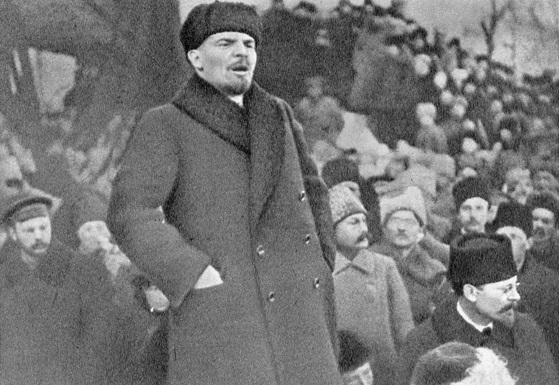
 The Crumb Dungeon